
Professional-gradenovel feedbackinminutes
Detailed analysis of your novel's plot, pacing, character development, and prose.



Thousands of authors trust Inkshift.
See Reviews“Exactly what I need to improve as an author.”
“I was legitimately blown away by the critique. Amazing tool.”
“Extremely impressive... Even better than my MFA program.”
What your critique covers
Fast, affordable, and tailored to your genre, each editorial critique covers major aspects of your novel.
Structure & Plot
Identify pacing issues, plot holes, and structural imbalances that weaken your story's momentum.
Character Development
Assess motivations, emotional arcs, and consistency for every major character.
Setting
Get feedback on immersion, believability, and world clarity; no matter whether you're writing fantasy or contemporary fiction.
Prose & Style
Improve sentence flow, clarity, tone, and descriptive power, along with concrete suggestions for rewrites.
Marketability
Understand how your novel aligns with genre conventions and what makes it appealing to readers, agents, or publishers.
Publishing Help
Get a sample query letter, one-page synopsis, and a list of comparable titles for your novel.
Actionable Suggestions
Every critique includes examples, suggestions, and editorial notes you can immediately apply.
Revision Roadmap
Your report includes a prioritized list of revisions so you know what to tackle first.
See a real example
See Inkshift's developmental editor in action. Take a look at a critique example to see the kind of book feedback you'll receive.
Overview
Synopsis
The manuscript follows Harry Potter, an abused orphan raised by his aunt and uncle, as he learns he is a wizard and enters Hogwarts School of Witchcraft and Wizardry. Across his first school year, he discovers a hidden magical inheritance, forms friendships with Ron Weasley and Hermione Granger, clashes with Draco Malfoy and Professor Snape, and becomes entangled in a mystery surrounding a guarded object later revealed to be the Philosopher’s Stone.
The central conflict is Harry’s gradual movement from passive, confused outsider to active moral agent as he chooses to confront the threat linked to Voldemort, the dark wizard who murdered his parents. Themes include belonging, courage, friendship, moral choice, and the difference between reputation and character.
Major Strengths
The manuscript’s strongest asset is its control of reader experience. The opening establishes the ordinary world with clarity and comic precision: phrases like "perfectly normal, thank you very much" and the repeated emphasis on the Dursleys’ hostility to "such nonsense" create an immediate tonal contrast that makes the magical intrusions land cleanly.
A second major strength is the architecture of discovery. The book consistently withholds information at the same rate Harry acquires it, which keeps the reader in active pursuit of answers. Examples include the repeated references to "the Potters," the delayed revelation of Hogwarts, the mystery of the package from vault seven hundred and thirteen, and the final reversal that Quirrell—not Snape—is the immediate antagonist.
Character accessibility is also effective. Harry’s desire for belonging is clear from early details such as sleeping in "the cupboard under the stairs," treasuring his scar, and his reaction to seeing his parents in the Mirror of Erised. Ron and Hermione are introduced with quickly legible, contrasting traits that generate chemistry and conflict. Hagrid functions as a threshold figure between worlds, combining exposition, emotional warmth, and comic unpredictability.
The narrative voice is a consistent asset throughout. It balances wry authorial commentary with child-accessible immediacy, and manages to hold comedy and menace in the same register without either cancelling the other. The setting reinforces this: Hogwarts is not merely decorative—moving staircases, portraits, ghosts, the Forbidden Forest, and the trapdoor chambers all generate plot, mood, and obstacle, making the world feel structurally alive rather than scenic.
Areas For Improvement
The highest-priority craft issue involves the delivery of key information. Several important reveals arrive through extended exposition rather than dramatized discovery—most notably Hagrid’s explanation of Voldemort, the Potters, and the wizarding world in Chapter 4, which concentrates a significant amount of backstory into a single scene. While the warmth of Hagrid’s character softens the informational load, the passage asks more of the reader’s patience than the surrounding scenes do.
A second issue is that several late-plot turns rely on convenience rather than fully earned causality. Hagrid reveals Fluffy’s weakness because a stranger "kept buyin’ me drinks," the Invisibility Cloak arrives anonymously at precisely the moment Harry needs to explore, and Dumbledore is lured away on the same night the Stone becomes vulnerable. These choices function within the story’s heightened register, but from a structural standpoint they ask for reader forgiveness rather than building their resolution through airtight logic.
A third issue concerns pacing in the middle section. The period between the troll incident and the identification of Nicolas Flamel introduces necessary worldbuilding and character material, but the Norbert subplot in particular functions more as a detour than as a contribution to the central mystery. The sequence delays the Stone investigation’s urgency at a moment when that urgency should be building.
These are revision-sensitive issues rather than foundational problems. The manuscript already has strong narrative momentum and reader investment—the goal would be sharpening the causal fabric at its thinnest points rather than restructuring what works.
Structure & Plot
Story Architecture
The overall architecture is strong and highly legible. The inciting incident begins with the arrival of magical disruption into the Dursleys’ world: owls, shooting stars, mysterious people in cloaks, culminating in Harry being left on the doorstep. The true story launch occurs when Hagrid tells Harry he is a wizard and delivers the Hogwarts letter—a moment that clearly redirects the story from domestic survival into portal fantasy.
- Act 1: The opening chapters establish Harry’s deprivation, the comic cruelty of the Dursleys, and the desire-driver of escape. The zoo scene and letter sequence build pressure through escalation. Cause and effect are clean.
- Act 2: Hogwarts functions as both setting-establishment and mystery escalation. Nearly every early school chapter adds worldbuilding and a new question: what is behind the trapdoor, why does Snape hate Harry, who is Nicolas Flamel, what is Voldemort after?
- Act 3: Harry learns Fluffy’s weakness from Hagrid, discovers Dumbledore has been lured away, and decides to act. This gives the climax a clear trigger.
The main structural weakness is that the final obstacle course depends on adults designing protections that are conveniently solvable by three first-years. Hagrid revealing the crucial first gate because a stranger "kept buyin’ me drinks" is the most exposed convenience in the manuscript. If revised for stronger causality, the protections should require not merely skill but a moral quality the villain lacks.
Continue reading the full critique on the example page...
How your manuscript critique works
Upload Your Draft
Upload your manuscript in .docx or .txt format. Submit a single chapter or your full story.
Choose Your Feedback Level
Select how deep you want to go:
Receive Your Analysis
Each story critique covers structure, characters, prose, and more, and is available in minutes.
How Inkshift compares
Expert feedback without the wait or the price tag.
| Feature | Inkshift | Traditional Editing |
|---|---|---|
| Turnaround Time | Minutes | 4–8 weeks |
| Price | $25 | $2,500+ |
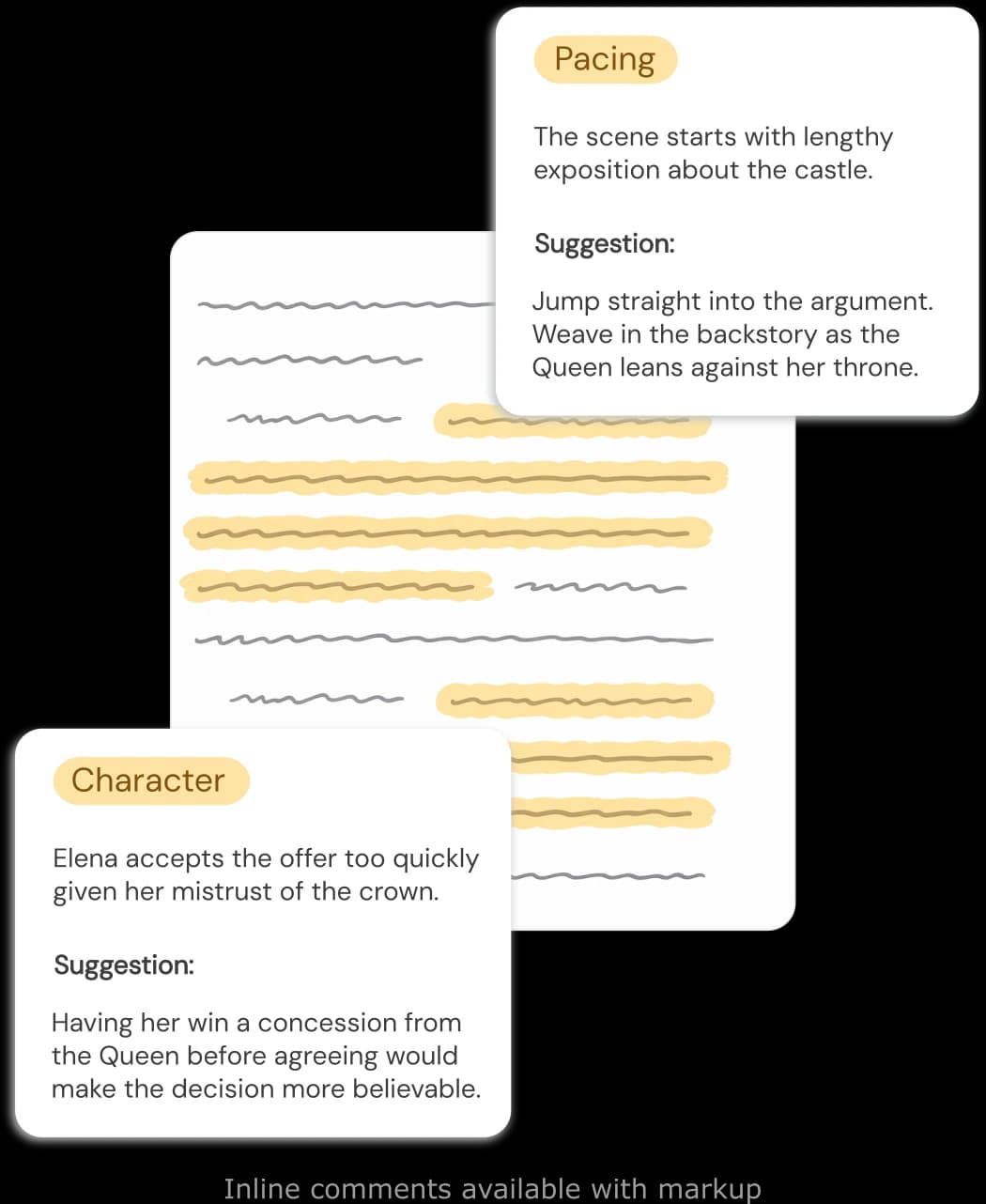
| Output Format | Structured report, revision plan, or inline markup | Letter and margin notes |
| Availability | 24/7, instant | By appointment, often with a waitlist |
| Dialogue & Iteration | Single report | Ongoing conversation with your editor |
Prices and timelines are approximate and may vary by service.
Pricing
Novel feedback in minutes. No subscriptions.
Starter
Critique of your first 10,000 words
Critique
A detailed assessment of all major aspects of your story.
+ Plan
Plus a chapter-by-chapter revision plan to address critique feedback.
+ Markup
Plus detailed line-level feedback and suggestions across your manuscript.
Private, secure & always yours
Never Used For Training
Your writing is never used to train AI models.
Deleted After Analysis
Uploads are deleted after processing.
Start your manuscript critique
Upload your manuscript and get personalized book feedback you can use in minutes.