How to Self-Edit a Novel: Step-by-Step Revision Guide
Self-editing is the process of taking an objective look at your own work and prioritizing edits to make it stronger.
The trouble is, you've spent months or years inside your draft. You know what you meant to write in every scene, which means you'll often read your intention instead of the actual page. Self-editing requires distance, order, and techniques that compensate for your own blind spots.
This guide gives you that order. If you want the broader version of the revision process, start with our multi-draft revision framework; this article focuses specifically on what you can do before outside feedback.
Why Self-Editing Is Hard
Before getting into methods, it helps to understand what you're fighting against.
Proximity bias. The longer you've spent with a manuscript, the harder it is to read it as a new reader would. Your brain fills in gaps because it already knows what should be there. A missing scene beat, an unclear motivation, an emotional turn that never made it onto the page. You skip over these because your memory supplies the missing pieces.
Intention versus execution. You know what you were trying to do. A reader only has what you did. The question is not whether your intention was good; it's whether the page delivers it.
Loss of scale. After months of writing, you lose your sense of the whole. You can't feel whether Act 2 drags across two hundred pages when you're looking at one chapter at a time and editing as you go.
Good self-editing methods are designed to work around those problems.
Step 1: Put the Manuscript Away
This is the single most important thing you can do, and the hardest because you're motivated after finishing your last draft. But you need to create distance. Put the manuscript away for at least two weeks before beginning revisions.
The goal is to make the text feel slightly foreign again. When you return, you want to encounter surprises: scenes that work better than you remembered, scenes that clearly fail in ways you couldn't see while drafting, and even sentences that work better or worse than you remember.
While the draft rests, don't tinker. Read in your genre. Work on something else. Let the manuscript go quiet. When you come back, you'll be closer to a reader.
Step 2: Read the Full Draft Before Changing Anything
Resist the urge to start fixing immediately. Your first pass should be a read-through with no editing. Ideally, read in one or two long sittings so you can feel the shape of the book.
As you read, note:
- Where the story drags. Mark the scenes that feel slow. Do not stop to fix them, but note where you feel bored.
- Where you're confused. If you are confused, a reader will be too.
- What is missing. Look for unresolved threads, absent motivations, missing emotional beats, and characters who vanish for too long.
- Where the story actually starts. Many first drafts begin twenty pages before the real beginning. It's the author telling themselves the story and giving themselves background before they really begin.
- Where the story changes. Each chapter must change the plot in some way, the characters, or preferably both.
Use a notebook or separate document. Don't edit the manuscript during this pass. If you start fixing sentences, you'll slow down. The scene you edit will improve, but you'll lose your higher-level vision of the story.
Step 3: Fix the Big Problems First
Work from large to small.
Structure before scenes. Scenes before paragraphs. Paragraphs before sentences. Sentences before words.
If you spend three hours polishing Chapter 7, then later discover Chapter 7 needs to be cut, you've wasted three hours and made the chapter harder to let go of.
Your first real revision pass should ask developmental questions:
- Is the plot working? Does the story escalate rather than drift? Are there causes without effects, or effects without causes?
- Are the character arcs complete? Does the protagonist change, resist change, or fail to change in a way the story earns?
- Are the stakes clear? Does the reader know what the protagonist stands to lose, and why it matters?
- Does the ending pay off the beginning? The ending of a novel is a kept promise. Check whether the opening chapters make promises the ending honors.
- Does every major subplot matter? A subplot should pressure the main plot, deepen character, develop theme, or change the climax. If a subplot can disappear without consequence, revisit how naturally it's woven into the main story.
Make structural changes first. Add scenes, cut scenes, combine characters, rearrange sequences, rebuild motivations. Fix the foundations before you start hanging pictures.
Step 4: Build a Reverse Outline
A reverse outline is one of the most useful self-editing tools because it shows you the book you actually wrote, not the book you meant to write.
For each chapter or scene, write:
- What happens?
- What changes?
- Whose point of view is it?
- What does the protagonist want?
- What is the obstacle?
- How does the scene leave the situation different?
If you can't write what changes in a scene, the scene may be filler. If the only honest summary is "the characters travel," "the protagonist thinks," or "two people talk about what already happened," the scene probably needs pressure.
The reverse outline also reveals pacing problems. Five chapters in a row that all do the same thing may not be escalation. They may be repetition.
We go deeper into this method in our reverse outline guide. But a word of caution: this method requires you to be honest with yourself. Do readers really need to see twenty pages of horseback riding?
Step 5: Revise at the Scene Level
Once the structure works, move to scenes.
Every scene should have a job. It doesn't need to be loud or plot-heavy, but it should change something. A quiet scene can still shift a relationship, reveal a lie, deepen stakes, complicate a choice, or alter the reader's understanding.
Ask what would break in the story if you cut the scene. If the answer is nothing, it's time to use the backspace key.
This is also the stage where you check transitions, chapter endings, entrances, exits, and pacing. You're no longer asking whether the whole story works. You are asking whether each unit of story is carrying its share.
Step 6: Revise for Character and Emotion
Many self-edits focus too much on plot mechanics and too little on emotional logic.
After the structural pass, read again for character continuity. Does the protagonist's behavior make sense from chapter to chapter? Are emotional reactions proportionate? Do relationship changes happen on the page, or do characters seem to become closer, colder, braver, or angrier between scenes without enough support?
Pay special attention to moments of major emotion: grief, betrayal, confession, attraction, shame, fear, sacrifice. These scenes only land if the story has earned them.
Ask:
- Has the reader been given enough reason to care?
- Is the emotional beat specific to this character?
- Does the aftermath last long enough?
- Does the character's reaction match who they have been?
If the emotional turn feels sudden, the fix is usually earlier in the manuscript. Add pressure, preparation, and specificity before the big moment rather than explaining the feeling.
Step 7: Line Edit Last
Only after structure, scenes, character, and pacing are working should you polish the prose.
This is where you tighten sentences, cut repetition, sharpen verbs, smooth dialogue, reduce filtering, vary rhythm, and remove clutter. It is satisfying work, which is why many writers start here too early.
Line editing is finishing work. It assumes the scene belongs in the book. If you are at this stage, our guide to confident prose can help with sentence-level polish.
If you want a complete manuscript pass once you reach this stage, Inkshift's Line Editing feature focuses on clarity, flow, rhythm, dialogue, and style while preserving the author's voice.
During the line pass, look for:
- Repeated words or sentence structures
- Dialogue that says exactly what the character means
- Filter phrases like "she saw," "he noticed," or "they felt" when direct experience would be stronger
- Over-explained interiority
- Weak verbs carrying strong moments
- Paragraphs that bury the important beat
Read uncertain passages aloud. If you stumble, the sentence probably needs attention. If the dialogue sounds like a thesis statement, let the character sound more human.
Step 8: Outside Feedback
This could also be Step 1, because it's something every writer needs at some point in their story's journey from draft to done.
Self-editing can only take you so far. As writers, we're too close to our own work to see it clearly, and an outside perspective becomes imperative. Whether it's beta readers or critique partners, professional editors, or tools like Inkshift, at some point, getting an outside perspective is the only way to improve.
Inkshift provides feedback on structure, pacing, plot holes, character payoff, prose quality, and more, but no matter where you get notes from, use outside perspectives early and often.
Other Self-Editing Techniques
Some of these might not work for you, some might. They're all worth trying to see what resonates.
Read Aloud
One of the best ways to experience your novel is to read it aloud, particularly as you get closer to line editing. Sentences can sound great on the page and poor when you hear them. It almost never works the other way around.
Sentences that sound good to the ear sound good in your head. Read aloud.
Print and Annotate
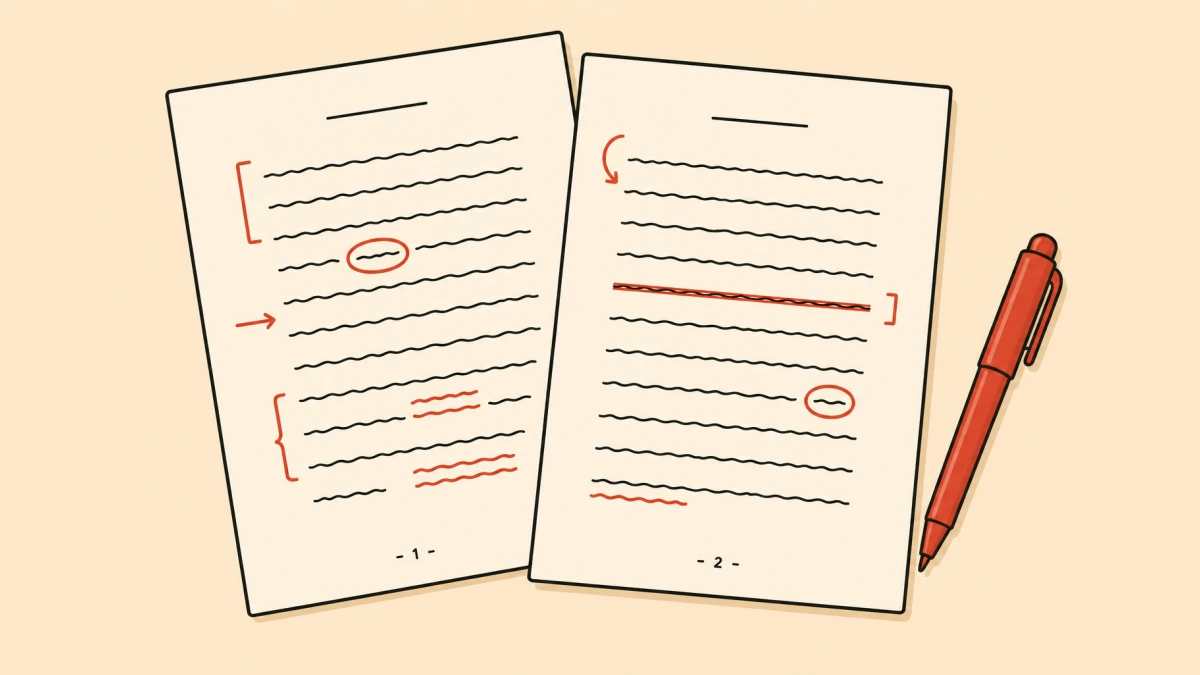
Reading on paper creates a different kind of attention. Many writers catch errors on a printed manuscript that they miss on screen, especially in dialogue, scene transitions, and overfamiliar passages.
Print the draft. Read with a pen. Mark the page.
Use Chapter Summary Cards
For each chapter, write a three-to-five-sentence card: what happens, what changes, whose point of view it uses, and where the protagonist ends emotionally.
Lay the cards out in sequence. You will see repetition, missing characters, flat emotional stretches, and plot threads that disappear.
Search for Your Habits
Every writer has default moves. Maybe your characters sigh, shrug, look away, smile tightly, blink, swallow, or glance too often. Maybe your scenes open with weather. Maybe your paragraphs lean on the same rhythm.
Make a list of your habits, search for them, and keep only the best examples.
Change the Format
Changing the manuscript's appearance can help you see it fresh. Export to PDF. Change the font. Read on a tablet. Print pages with wider margins. The words are the same, but your brain is less likely to glide over them. Often, the errors you catch are when one line wraps to the next on your regular text editor.
Common Self-Editing Traps
Over-indexing on Chapter 1. While the opening of your book is critically important, it's not the only important chapter.
Editing what's there but missing what is absent. Self-editing is about noticing missing beats: the motivation that never made it onto the page, the consequence you skipped, the scene the reader needed but did not get.
Treating all notes equally. A weak metaphor and a broken character arc are not the same size problem. Prioritize the issues that affect the whole manuscript.
Revising forever. Self-editing can become a hiding place. At some point, you need outside readers because you've taken the manuscript as far as you can alone. It's scary to get feedback and learn about your blind spots and weaknesses, but that's the only way to grow.
Stopping too early. One pass is never enough. Most manuscripts need a structural pass, a scene pass, and a line pass at minimum.
Conclusion
Self-editing, when done properly, can transform your manuscript from a work in progress to a polished novel. Use these techniques to improve your craft and your manuscript.
- Put the manuscript away for at least two weeks.
- Read the full draft before making changes.
- Diagnose the largest problems first.
- Fix structure before scenes and scenes before sentences.
- Build a reverse outline.
- Check whether every scene changes something.
- Revise for character continuity and emotional logic.
- Line edit only after the story works.
- Read important scenes aloud.
- Get outside feedback.